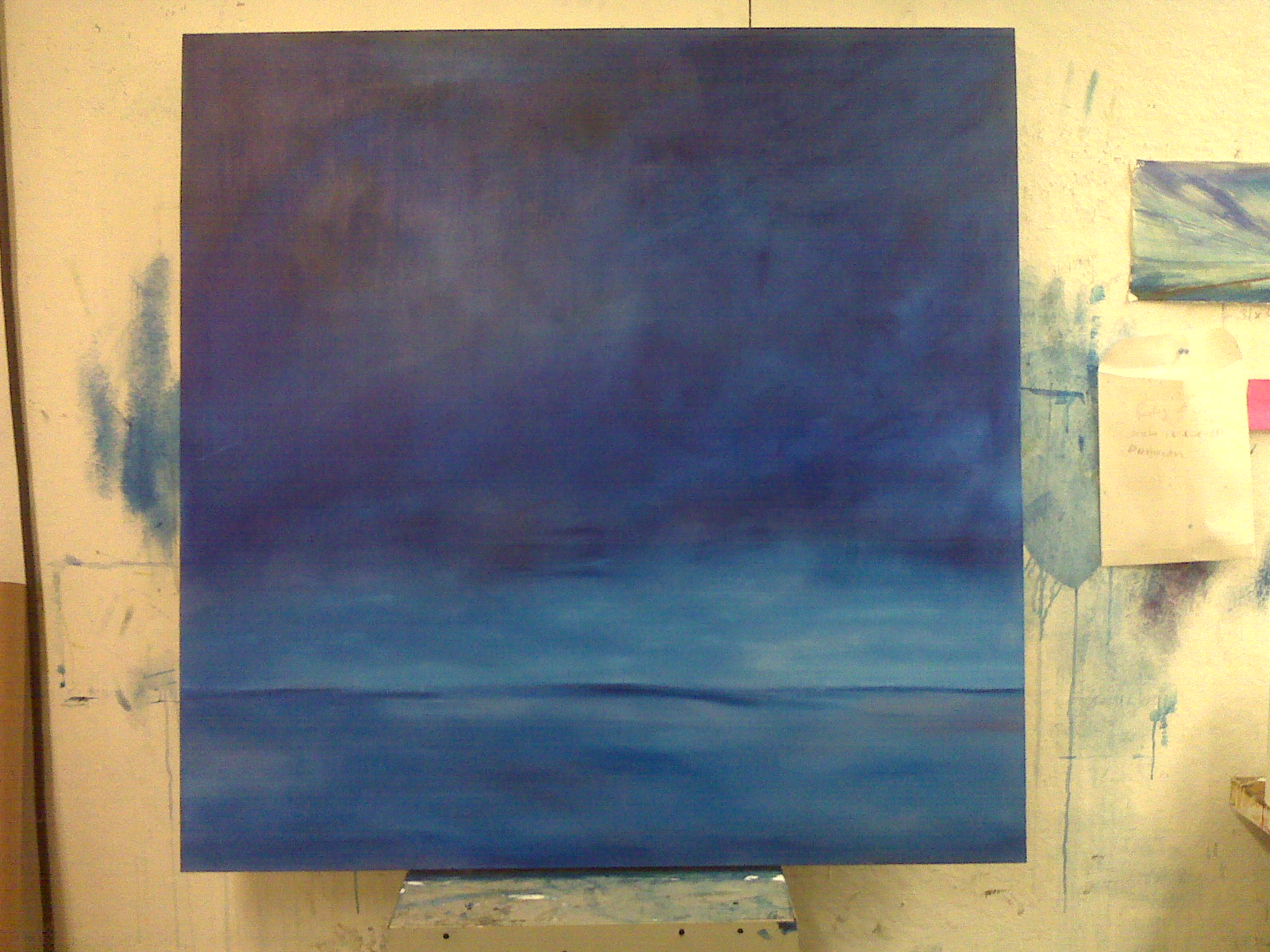
Wednesday, April 27, 2011

Anselm Kiefer


A German painter and sculptor, Anselm Kiefer has been influential to me over the past few years.  When I first saw his work I was impressed by the scale and the amount of spatial rendering in them.  Rather than his subject matter, which dealt with issues ranging from the impact of german nationalism and the third reich to mythology, I am particularly fond of the formal elements.  This includes the illusion of space in his paintings and the colors used and the feelings/emotions that they evoke in me.  

Thursday, April 21, 2011

Paintings hung


Here are two pictures taken with my phone of them up. I am going to go in tomorrow morning with fresh eyes and finalize everything that needs to. I am very happy with how everything turned out.


Wednesday, April 20, 2011

Walls painted

Yesterday I got all of the walls in my space painted except for a few spots that need to be worked with a hand brush. I think the color came out very nice, I am pleased with it. I am excited to decide which pieces go where and play around with the lighting.

I plan on finishing the painting in Dowd today. Tonight I will paint the remaining edges on a few paintings and tomorrow hopefully I can get all of my paintings in Dowd and start to hang. Just in time to go home for the Easter weekend.

Maybe I'll post some pictures later.

Wednesday, April 13, 2011

Richard Serra


Last spring I visited the DIA Beacon and really admired what I saw.  For a while I had been interested in Minimalist Art and enjoyed reading/listening about it in class, but actually seeing it in person, which is the point of this art, was even better.  Walking through Serra's torqued spirals was a lovely experience, especially being the only one occupying it.  The giant walls tilted at an angle feel like they were enclosing me in this small space.  Not being able to see around the dark turn added to this sense of  calming uneasiness.  I use that word because I knew I was safe in this environment, yet I couldn't help to pretend that I would actually get trapped in here.  Walking in this enormous circle felt like I was in there for a long time, yet the walk was brief.  When I reached the center of the sculpture it opened up slightly and I was able to look up at the entirety of the piece.  


"Richard Serra has long been acclaimed for his challenging and innovative work, which emphasizes the process of its fabrication, characteristics of materials, and an engagement with viewer and site. In the early 1960s, Serra and the Minimalist artists of his generation turned to unconventional, industrial materials and began to accentuate the physical properties of their work. Relieved of its symbolic role, freed from the traditional pedestal, and introduced into the real space of the viewer, sculpture took on a new relationship to the spectator whose phenomenological experience of an object became crucial to its meaning. Viewers were encouraged to move around—and sometimes on, in, or through—the works, many of which cannot be fully understood without peripatetic examination. Over the years Serra has expanded his spatial and temporal approach to sculpture and has focused primarily on large-scale, site-specific works that create a dialogue with a particular architectural, urban, or landscape setting."

Monday, April 11, 2011

For Ji


As I read this book in January I marked certain passages that I found to resonate with my concept. This particular excerpt I found to be interesting for what Ji is working with.


Edited Painting

"Movement takes away the excess charge of psychic energy that disturbs our efforts to quiet our thought process."
-Rev. Lauren Artress


This painting was too dark and unfitting in my series so I worked on it a bit. The kwality is not the best.


Sunday, April 3, 2011

Show postcard


And I realize 'EXIBITION' is spelled wrong, I caught this mistake yesterday. This was a screen shot I took before fixing it.


Thursday, March 31, 2011

New Painting In Progress


Started this last night, about an hours worth of work for the first layer. Again, emphasizing the "glowing" horizon line. I will work on it over the weekend and post new pictures. Dimensions are 47x47"

Friday, March 25, 2011

In Progress Painting Update


Posting a picture of it again to see how different it looks after a little more paint. I sat down and looked at it for a little bit and some thoughts came to me. It feels a bit redundant saying this again but I think each time I do, a little more comes out and I will be able to piece it all together.

These are my emotional and psychological states. That moment in time when I feel euphoric. Not at one time. Not only during and not only after, which is why it's the culmination. I take pieces of each. When I'm out there and observing and physically there in the space. Along with after. When the memories are forming. Since that is what I am primarily working with.

The stray marks are what I find interesting. In nature, they can be materialized in the sky, in the clouds. As the edges of the clouds dissipate and soften out into nothing. That helps capture the feeling of weightlessness and floating.

Float being an idea for a possible show title.

Thursday, March 24, 2011

New Painting (In Progress)


The lighting captured in the photo (taken with my phone, so not the best quality) might not be 100% true to the lighting in person, but it gives you an idea of what it looks like. I am continuing to work with the horizon line as the main focus. I really enjoy how it looks when I make it thicker and darker (that's what she said?).

I am liking the direction to where it's headed. Which I would say is North/Northwest...give or take a few degrees.

Saturday, March 12, 2011

Prints

These screen prints are related in a way to the concept that I am working with. For a while now I have wanted to incorporate photographs with my paintings, but could never come to a decision. The photographs that I used for these screen prints are directly related to where I have run. One of the roads pictured is Gracie Road, a road that I run on from time to time. Back when I referenced photographs for my paintings, it was photos like this that I used. The reason why there is selective coloring in the prints is because when I am done running, there are only certain things that I remember. It would be impossible to remember every detail of every run. Whether it is a certain patch of trees, a stretch of road, or a meandering stream, I only remember certain parts of most runs. And my mem­ories of anything for that matter typically are lacking color. Which is why small bits of color are added to the black and white prints.

Wednesday, March 9, 2011

Photo Silk Screens


These are screen prints that I made for Fibers III, and I am considering adding something like this to my Thesis show. I really don't feel like going into that right now, so I will save that for a later time.

Sunday, March 6, 2011

Discussing a painting


This is my favorite painting from this semester thus far. I like it because of the glowing quality that the horizon holds underneath the airy sky. The blues and whites in the sky give off such a weightless feeling that I can see myself breathing in the cold air that exists in that world. The triangular shape that is developing above the horizon is ambiguous in that it is not being labeled as anything in particular. It could be a cloud forming in the distance, it could be a mountainous formation, or it could be something else. When I am out there running, I am constantly taking in what is around me. This is the result of that. How it is not identifiable as one object, but rather it is a combination of many things.

Thursday, March 3, 2011

Some more thoughts

On my run this morning, 7:48 A.M., Lighthouse, when I got to the top of the first hill I looked across the field to the left and it was beautiful. Sunny, snowy field, there were posts in the field. I could only look at it for a brief moment though before it was gone.

Light source in my paintings-
As I am running in different directions, North, West, East, South, Northeast, Southwest, etc. the location of the sun is always changing. Rather, I am constantly changing/moving in relation to the sun. So sometimes I am looking across a field with the sun behind me. Other times the sun might be in front of me... And certainly there are runs in Central N.Y. when the sun isn't even shining.

It really is the culmination of my running experience. But these paintings aren't solely about running. It just happens to be the easiest way for me to feel most connected with my surroundings, outside. And those memories and feelings don't fully augment until after the act. Like now, 12:16 P.M. There are glimpses, brief moments that I remember, and I guess that is what I am painting.

These paintings are the experience of it all. Before (not so much), during, and after. During is when I am subjecting myself to the world, physically being there and taking everything in. The harvesting of it all if you will. Then after is when the "magic" happens. When everything that is in my head takes its course and produces something.

What is more important, the sky or land?

Neither. There wouldn't be land without sky, and there wouldn't be sky if land didn't exist. But more truthfully, they are both equally important. Although I admire the sky a bit more. I think this is because I enjoy looking upwards when I am out there. I'm more susceptible to "loose myself" in those moments. Have one of those moments where everything is....

Wednesday, March 2, 2011

"Doug Marx' Artist Wednesday

This first Wednesday of March I chose Doug Marx as the artist of choice for the bi-weekly event titled "Artist Wednesday".  Doug Marx is an artist similar to Keith Jacobshagen, being that they are both landscape painters from the Cornhusker State of Nebraska.
On his website located here, you can read about his bio.  He lacks an official "artist statement", although he does say, "So, for over twenty years now, I have painted the sunrises, the sunsets, the skies, fields, prairies and rivers that have always surrounded me and my family. I never long for what is somewhere else. Each day brings forth a new challenge to filter first through my eye, then my hand. As long as I can see and paint, I want for nothing."

What I like about his paintings is what I like about every other painting that I have discussed on here.  That is the feeling of solitude and expansiveness being depicted.  The large skies and empty fields are very quiet and uninhabited, yet they posses this feeling of something overwhelming.  


Saturday, February 19, 2011

KJ Interview and Historical References


Q: And you don't go out of your way to disguise your brush strokes. You've got this nicely rendered little grain bin, and then you've got this mark here. Do those marks have equal value, equal importance to you? I assume that they do.

A: Yeah, they do. I'm constantly walking this tightrope between wanting to describe something in reality, in a sense, and, at the same time, allow a departure from the reality with the paint itself. That the real reality of a painting is the way a painter applies the marks. But at the same time, there's a trick that goes on that fools the eye and allows you to see something, to represent something. Those things, I think, are something serious realist painters are constantly dealing with, working on and thinking about


Above was taken from an interview with Keith Jacobshagen. I can relate to what he is talking about because I deal with this a lot. Many times I find myself questioning how I want something to look. "Do I want it to look realistic or not?" This is an on going struggle that I think t I am losing.

It always seems like in my head I want a painting to look a certain way, and that there is one way to accomplish that. I would like to say that I want to approach the canvas in a more minimalist approach. That's not saying that I want to mimic that of a minimalist. I am trying to put on canvas just enough so that you know what is there. Rather than detailing a tree or a wooden post, I would like to put a mark that could be read as such an object. It is that moment I am remembering, so all the details are not there embedded in my brain.


Several weeks ago I read through the book "Spirit of Place" and I am going to share the artists (and hopefully post the painting) that I found to be helpful in one way or another to my own work.


1. Milton Avery "Tangerine Moon and Wine Dark Sea" 1959

"His process was reductive, gradually distilling an image to its most elemental shapes and patterns. The use of color was intuitive and expressive, freed from the dual constraints of nature and theory. Ultimately, they were lyrical expressions of the minor moments and simple pleasures of nature."

I chose this particular painting because I like how he has the uninterrupted horizon line like I do, along with the sky/land ratio.


2. Paul Resika "Horseleech Pond, Indian Red Sky" 1984

"...his ability to compress the particulars into their essential, emotive characters. The transient quality of the Cape light, is stripped of all that is superfluous, leaving only the pith of its fleeting mood."

This painting is not detailed at all. It is very painterly with evident brush strokes composing the clouds and trees. I like this because of that. The lack of detail makes it easy for me to project myself into the land.


3. Keith Jacobshagen "N.W. 84th St. & Agnew Road" 1983

"Something about the road paintings- they came about as a kind of way to go home- a formal epiphany of the journey. When I was a kid in the midwest it was a tradition to go for a Sunday drive. If the day was hot, then a country drive in the late afternoon to escape the heat of Wichita was a treat. I have fond memories of those warm late afternoons with their cool shadows stretching across gravel and dirt roads- sitting in the back seat of my father's Ford looking between my parent's heads at the road that seemed to move out, cutting through the wheat of grass fields. I think the space and thrust of those roads and how they defined the slight slope and flatness of the planes- the distance of things attracted me in an intuitive way."

This is perhaps my favorite painting in the book. It is the combination of the vast open skies and distance portrayed in his paintings that attract me to Keith Jacobshagen. Although he treats the paint differently than I do, it is this general feeling of the land that I try to capture. That feeling is one of expansiveness, of solitude.


4. Peter Poskas "Dawn, Nettleton Hollow" 1987

"His paintings of the farms, fields, and surrounding landscapes are distinctive in that he describes the nuance of change brought on by the progression of seasons, and the subtle shifts of mood created by the transient acts of light and weather."

I marked this painting because this scene reminds me of central new york in the winter. With the contour lines in the field under the pinks and oranges of the setting sky, it reminds me of a place where I once ran.


5. John Button "On Noyac Path" 1982

"...they emphasized nature's moods over its physical characteristic. If they painted what they saw, then it must be remembered that they selected those movements to retain. It was a move away from the objective stance of Contemporary Realism, but it was also the beginning of a return to the spirit of the luminists of the nineteenth century, who viewed the landscape with a sense of wonder."

I like the clouds in this painting that emphasizes the space. Placed low at the horizon line, the clouds help give off that glow at late evening after the sun has set. As you look up in the sky the more cool colors you see.


6. Robert Birmelin "Tidal Flats, Deer Isle, Sunset" 1978

"closer than courbet to his landscape sources [but] not as close as Millais is to his best pre-Raphaelite bramble thickets"

This painting is great because it does a lot to show off the distance. The horizon line is placed high in the composition to give me the feeling that I am standing in the foreground. He layers rocks on another to give a sense of the scale of them. The clouds in the sky emphasize the moodiness in the painting.


7. Sylvia Plimack Mangold "Zodical Light" 1980

Based on direct observation. "The trees and hills are all familiar subjects....I choose a subject I can return to over and over again so that the landscape is absorbed into a personal vocabulary. So that I can extend myself (my mood) into the mood of the space around me....."

I think her quote sums up what I am thinking. That personal vocabulary...extending her mood into the mood of the space around her...


Wednesday, February 16, 2011

Artist Wednesday

Toni Grote is my artist of choice for today, the Artist Wednesday of February 16 year 2011. I have discussed Mrs. Grote in the past and I thought it would be good to mention her again now. After not seeing her paintings for several months, it was nice to look back at them and reflect.

When I first started to paint these landscapes I came across Toni Grote and I was amazed. It was uncanny how similar we were working (to an extent). The way she divides the canvas is very similar to mine, along with her portrayal of these vast scenes.

It is interesting to see how many paintings she has of oceans since she lives in rural Iowa.


Monday, February 14, 2011

Elements of the creative process

Running is the easiest way for me to feel most connected and in tune with my surroundings.

What is that feeling like?

Happy, content is a better word. My body and the landscape (my surroundings) are feeding off of each other. The more beautiful the environment, the better it makes me feel inside, and the more removed I feel from my body. That is the feeling of "floating" that I described earlier.

It is the beauty of my surroundings that I am remembering.

Remembering of how I felt at that time, the weather, temperature, and the characteristics of the land.

But as I recall those memories, the point of view that I am seeing, is not from my own eyes. It is more of a view from above. Like the viewer is lifted out of my head, hovering slightly over. I think this is because as I am looking around at my surroundings, I am trying to capture and take in as much of it as I can. And the memories I have are of all of them mixed into one. Therefore I am not in my head.

I said that running is the easiest way for me to feel most connected with my surroundings, but it is not the only way for that to happen. It can occur while I am walking or hiking, and even driving. I think running is the easiest because I am moving through space at a faster pace, and I am able to see more that way. I can experience a lot through a relatively short amount of time. Walking or hiking on the other hand, is more of a slower process. I am still able to experience where I am in a physical way; it is just toned down a bit. The process takes a little longer. And I mentioned driving. I only experienced that feeling once by driving. And I think that was because I had been driving by almost 20 hours, and the land that I was driving by was so peaceful. After all, while driving, you are far removed from the outside world. You are in your own bubble, behind a piece of glass. Glass that is separating you from nature.

So how am I visually creating what I am verbally explaining? Good question, I am glad that you asked.

Like I said earlier, I am remembering of how I felt at the time. So it is the culmination of it all. I take into consideration the weather, the land terrain, the lighting, the particulars found in the land-such as corn stalks, streams, hills, etc., and my physical and emotional states. I internalize these and mesh it all into one form. And what are produced are my paintings.

So I take bits and pieces of memories that I have, and piece them together into way that I think will make a solid composition.

I seem to have a desire to depict physical space (distance) in my paintings. There is something about manipulating the surface that I am interested in. Being able to show space and depth on a flat surface is an idea that I like. I think this is because when I am out running, most of the time I like to look across to the horizon line. Being able to look across vast amounts of land, up to several miles, and still be grounded in one place (almost) is fascinating. I like to pretend that I am able to spread myself across all that distance, being able to be miles away at that horizon line and still be running where my body is.

I like to show that space in my paintings. I also like to do this to emphasize the sentiment of solitude. Typically, I run by myself. I can go up to 2 hours without seeing someone or speaking a word. It is in this time of personal detachment where I am able to be alone with myself, and listen to my interior noise. ""Running silences the exterior noise, but provides a place where the interior noise can be heard. It is impossible to silence the interior noise; it must be heard." -Roger Joslin

My paintings also tend to show more sky than they do land. This is because as I enjoy looking out across the land, I also like to look up towards the sky. It helps me forget about the pounding that my legs are taking on the hard surface, and helps put me at ease. I wish I could be floating up away into the clouds. I take an interest in also showing space in the sky, opposed to showing it on land.

The points of view in the paintings seem to change in relation to the composition. Sometimes the point of view suggests that the viewer is hovering off of the ground, while other times it does not. And sometimes it might show both. It might appear that you are looking up at the sky while looking down at the land.

This can be explained by revisiting what I said earlier.

When I am out running on the roads, trails, anywhere for that matter, I am constantly taking in and observing my surroundings. When I think back to those runs, I am re imagining them from all point of views, not just one. So it makes sense for the point of view to be mixed.

The colors that I choose are ones that I want to reflect this time of calmness and tranquility. Blue happens to be my color of choice for this reason. I find blues to really allude to that feeling of floating and mindful detachment.

Why I choose to use a larger canvas rather than a smaller one is because I want the viewer to be able to feel him or herself in my space. I like to pretend that I am actually in the space that I am looking at when in front of my paintings. I find this much easier to do in front of a large canvas opposed to a small, undersized canvas.


***To be finished later***

Statement

What I am painting are scenes that inspire me when I am most in tune with my surroundings in nature. There are several ways in which that can happen, the easiest being running. Although running is not the only way to experience it. It can occur while walking and driving as well. The scenes that inspire me are ones taken from actual locations. I internalize them, and what is produced is the culmination of it all. The physical act of moving; along with the weather, temperature, characteristics of the land. They are all meshed into one, and what I create are the offspring of it all.


I'm sure this can definitely be tweaked. But for now it is okay. I'm looking forward for feedback so that I can re-work it.